
Artificial Intelligence in IVF: How AI Is Transforming Reproductive Health
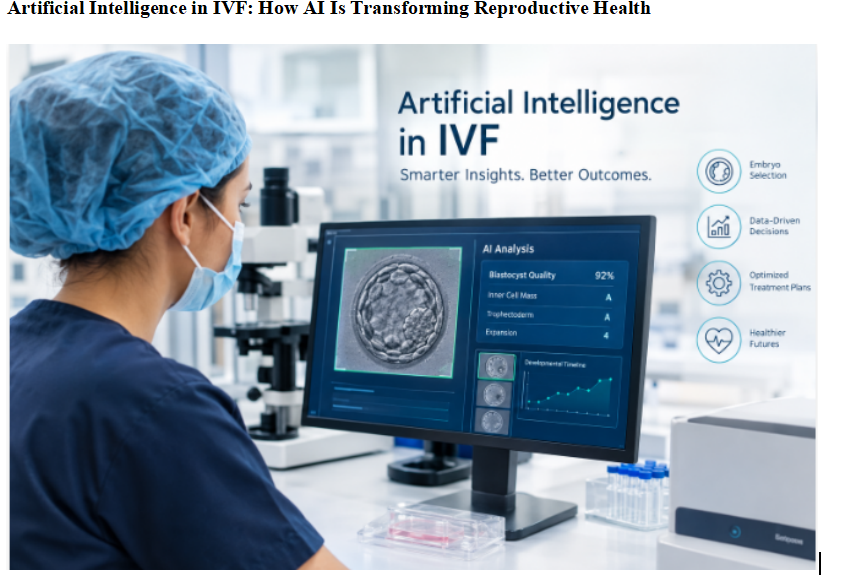
What Is Artificial Intelligence in IVF?
Artificial intelligence in IVF refers to the use of machine learning, deep learning, computer vision and data analytics to analyze large amounts of clinical and laboratory information.
Unlike conventional assessment, where an embryologist evaluates an embryo based primarily on morphology and developmental characteristics, AI systems can analyze thousands of image and time-lapse data points and identify patterns that may not be easily recognized by the human eye.
This creates an opportunity to support fertility specialists and embryologists in making more consistent, data-informed decisions.
Where Can AI Be Used in IVF?
1. AI-Based Embryo Selection
One of the most actively researched applications of AI in IVF is embryo selection.
AI algorithms can analyze embryo morphology, developmental timing and time-lapse imaging to estimate which embryos may have a higher probability of implantation or pregnancy.
Traditional embryo assessment may consider parameters such as:
- Blastocyst expansion
- Inner cell mass quality
- Trophectoderm appearance
- Fragmentation
- Cell division patterns
- Developmental timing
AI can potentially integrate these characteristics with large datasets to provide an additional layer of decision support.
However, AI should currently be considered an adjunct to embryologist assessment rather than a replacement for expert clinical judgment.
2. Time-Lapse Embryo Imaging
Time-lapse incubators continuously capture images of developing embryos without requiring repeated removal from the incubator.
This generates a large amount of morphokinetic data information about how and when an embryo develops.
AI can analyze this information to identify developmental patterns and potentially predict outcomes such as blastocyst formation, implantation or pregnancy.
Recent research has demonstrated considerable potential, but clinical validation remains essential before AI-based predictions can be treated as definitive measures of embryo viability.
3. AI and Ovarian Stimulation
Another emerging application is the personalization of controlled ovarian stimulation.
IVF stimulation involves multiple variables, including:
- Age
- Ovarian reserve
- AMH levels
- Antral follicle count
- Previous IVF response
- Gonadotropin dosage
- Follicular development
Machine-learning models can potentially analyze these variables to help predict ovarian response and support individualized treatment planning.
The long-term goal is simple: the right stimulation strategy for the right patient.
4. AI in Sperm and Gamete Assessment
Computer vision and machine learning are also being investigated for sperm analysis and selection.
AI-based systems may analyze characteristics such as:
- Sperm concentration
- Motility
- Morphology
- Movement patterns
Similar approaches are being explored for oocyte and gamete assessment.
These technologies could eventually provide more standardized assessments, although their clinical utility and effect on live-birth outcomes require further validation.
5. AI in the IVF Laboratory
AI is not limited to embryo selection.
Emerging applications include:
- Automated embryo grading
- Laboratory workflow optimization
- Embryo witnessing and identification
- Storage management
- Image analysis
- Quality-control systems
- Decision-support tools
- Potential automation of selected laboratory procedures
The American Society for Reproductive Medicine notes that AI applications in the IVF laboratory are expanding, while emphasizing the need for rigorous validation and evidence-based implementation.
Can AI Predict a Genetically Normal Embryo?
This is one of the most interesting areas of reproductive AI.
Researchers are investigating whether AI can use embryo images and developmental characteristics to estimate the likelihood of euploidy, meaning the presence of the expected chromosome number.
However, morphology and appearance cannot simply be equated with genetic normality.
For patients undergoing preimplantation genetic testing for aneuploidy (PGT-A), genetic testing remains a distinct laboratory process.
AI may eventually become an additional predictive tool, but it should not currently be presented as a replacement for validated genetic testing.
AI + Embryologist: Collaboration, Not Replacement
The future of IVF is unlikely to be AI versus embryologist.
It is more likely to be: AI + Embryologist + Clinician + Patient
AI is exceptionally good at processing large datasets, recognizing patterns and performing repetitive analytical tasks.
Embryologists contribute something equally important: scientific interpretation, laboratory expertise, quality control and clinical experience.
The most useful role for AI may therefore be to augment human expertise rather than eliminate it.
What Are the Challenges?
Despite its potential, AI in reproductive medicine has important limitations.
- Data quality: AI models are only as good as the data used to train them. Poor-quality, incomplete or biased datasets can produce unreliable predictions.
- Generalizability: An algorithm developed using embryos from one IVF laboratory may not perform identically in another laboratory because patient populations, protocols, incubators and laboratory practices can differ.
- The "Black Box" Problem: Some AI models provide predictions without clearly explaining how the decision was reached. In reproductive medicine, where decisions can have significant emotional, financial and clinical consequences, interpretability and transparency are extremely important.
- Clinical validation: High accuracy in a retrospective dataset does not automatically mean that an AI system improves pregnancy or live-birth outcomes. Large prospective studies and randomized controlled trials are therefore essential.
What Does the Future Hold?
The future of reproductive medicine may increasingly involve precision fertility care, where clinical information, laboratory data, imaging and molecular information are integrated into personalized decision-support systems.
AI could eventually help clinicians answer questions such as:
- Which stimulation strategy may work best for this patient?
- Which embryo should be prioritized for transfer?
- Which laboratory processes can be standardized or automated?
- How can we reduce unnecessary variability in IVF care?
However, the goal should not simply be to introduce more technology.
The real goal is to use technology when it produces better, safer and more meaningful outcomes for patients.
Conclusion
Artificial intelligence is becoming an important research and innovation area in IVF and reproductive health. Its applications range from embryo assessment and time-lapse imaging to ovarian stimulation, gamete analysis and laboratory automation.
The technology is promising, but it is not yet a magic solution for infertility.
The next phase of reproductive AI should focus on clinical validation, transparency, patient safety and measurable outcomes such as pregnancy and live birth, rather than relying solely on algorithmic accuracy.
The future of IVF may not be about replacing the embryologist with artificial intelligence.
It may be about giving embryologists and fertility specialists better information, better tools and better decision support.
AI may not replace human expertise in IVF—but it could help human expertise become more precise.
References
- American Society for Reproductive Medicine (ASRM). (2026). Artificial intelligence in the in vitro fertilization laboratory: A committee opinion. Fertility and Sterility, 126, 494–498.
- Cohen, J. et al. (2025). Artificial intelligence in assisted reproductive technology: Separating the dream from reality. Reproductive BioMedicine Online.
- Rajendran, S. et al. (2024). Automatic ploidy prediction and quality assessment of human blastocysts using time-lapse imaging. Nature Communications, 15, 7756.
- American Society for Reproductive Medicine (ASRM). (2024). The use of preimplantation genetic testing for aneuploidy: A committee opinion. Fertility and Sterility, 122, 421–434.
- Predicting pregnancy outcomes in IVF cycles: A systematic review and diagnostic meta-analysis of artificial intelligence in embryo assessment. (2025). Journal of Ovarian Research.
- Reddy, K. R., Asif, M., Deotale, G., & Priya, V. G. S. (2026). Artificial intelligence in embryo selection: enhancing precision and overcoming traditional limitations in in vitro fertilization. International Journal of Reproduction, Contraception, Obstetrics and Gynecology, 15(2), 789–797. https://doi.org/10.18203/2320-1770.ijrcog20260214